

Laser Treatment for Tinnitus, Hyperacusis, and Meniere's Disease
The inner ear has highly specialized cells and is a complicated organ.
Tasks of organs Hearing and Balance
The basic biological tasks of the organs of hearing and balance (equilibrium) for both humans and animals are:
- Early warning of danger and
- Communication to take necessary measures as well
- Guarantee for special orientation
We hear even if the sound can be behind us to the left, above or below us, next to us, or in front of us.
The same applies to our organ of balance in the inner ear, in the labyrinth, which allows a three-dimensional orientation in the space around us. Collaboration of hearing and balance constitutes the communication and navigation equipment system of both humans and animals. So like the navigation system of an airplane, which is influenced by external forces that determine the way it is built and functions, physical forces affect hearing and balance in the organism, which then determines how its organs are constructed and the biological work to be done. The physical forces, which are brought to bear on the organs of hearing and balance, which will then process these stimuli are:
a. of sound pressure and the frequency of the sound waves for organs of hearing and
b. of gravitational force and rotary movements for organs of balance
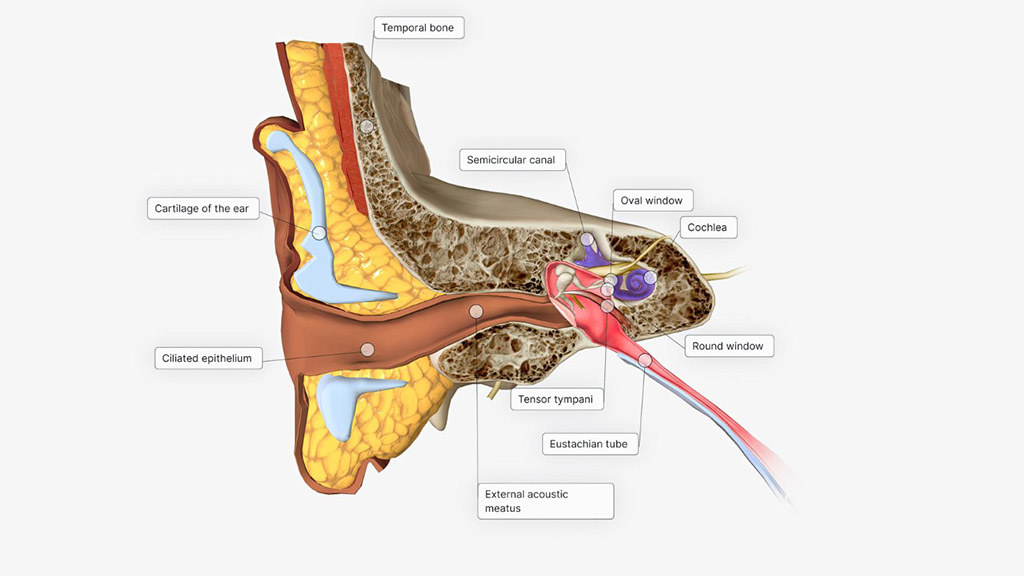
The Anatomy of the Organs Hearing and Balance
The sound is captured by the external ear and conducted through the external hearing passage. Sound pressure and the frequency of the sound wave cause the eardrum to vibrate. These are aimed at the hammer. The hammer is connected to the anvil and directs the vibrations onto the anvil, and from there onto the stirrup, the third member in the chain of the small hearing bones in the middle ear (or drum cavity). The plate on the stirrup lies in the elastic oval window in the inner ear and conveys vibrations and sound pressure further into the inner ear.
Only in the third part of the organs of hearing and balance do the external signals convert into biological signals (nerve impulses). With this third part of the organs of hearing and balance, the inner ear, achieves the largest and most difficult part of the work (cellular work). The fourth part of the hearing apparatus, the auditory nerve, then only has to carry out the signals that are produced over to corresponding areas of the brain, to hear, the hearing center, for balance, the brainstem, for us to perceive the experience of hearing and balance.
Tinnitus, Meniere's disease
The inner ear has highly specialized cells and is a complicated organ.
In the inner ear, there are approximately 20,000 receptor cells that react to sound. There are sound receptor cells in the inner ear that respond to special frequencies and there are wide band receptors. Together, they create a complex impulse flow that is processed in the brain and then experienced as sound.
Other lasertreatments
- Achilles
- Acne / Pimples
- Alopecia - Areata (spotted hair loss)
- Arm/ Tennis Elbow / Golf Elbow
- Back and neck pain
- Blood Vessel Removal
- Breathing difficulties/ respiratory problem
- Facial Pain
- Facial paresis / facial paralysis
- Fibromyalgia
- Fracture pain
- Gout
- Hair Removal
- Joint disorders
- Knee / Osteoarthritis / Wear and tear
- Migraines
- Muscle Aches
- Neck and Shoulder Problems
- Pigment spots and moles
- Plantar Fasciitis
- Pollen allergy
- Rosacea
- Scar
- Skin Tightening & Wrinkles Fractional CO2 Laser
- Sports injuries
- Stretch marks
- Tattoo removal
- Tendinitis
- Wart removal (foot warts)
- Wound